
Features of group equipment on a water trip
The main items of group equipment for water tourists are kayaks, boats or rafts. Each of them has its own varieties and types, but they all must have certain seaworthiness - buoyancy, stability, unsinkability, controllability, strength, etc.
Collapsible kayak. The most versatile vessel for travel. It is very light, transportable and has excellent driving characteristics, allowing it to be used also under sails and with an onboard motor.
When traveling kayaking, you need to take with you several waterproof bags for storing equipment and food, a rubber bulb-syringe for sucking water out of the kayak and rubber floats to ensure its unsinkability. Typically, the floats are air-filled basketball or motorcycle bladders, which are inserted into the bow and stern compartments and placed along the bulwarks.
When planning a route along small rivers with a fast current or a rocky bottom, it is necessary to strengthen the shell of the kayak with a sticker (on the keelsons and the lower belt of the stringers) of rubber protectors 4-6 cm wide and 1-1.5 mm thick.
If the kayak does not have an apron, then it is made independently from thin rubberized fabric. To anchor the kayak, it is advisable to tie a line to the kayak - a nylon cord with a diameter of 4-6 mm, a length of 3-5 m, at the end of which a duralumin peg is attached to anchor the vessel. Wire holders for oars should be attached to the sides.
In areas with frequent and heavy rains, it is advisable to make an awning for the kayak from waterproof fabric. The length of the awning depends on the design of the kayak, and the height of the posts should be 25-30 cm greater than the person sitting in the kayak. At the ends of the awning you can cut out wedge “wings” and sew zippers to them, which will protect from frontal or stern rain (Fig. 8).
Boats. Non-dismountable 2-5-seater wooden or fiberglass boats are used in areas where they can be rented at a tourist base or from the local population. The boat must be equipped with spare oars, rowlocks, a bucket for emptying water, painters and life-saving equipment.
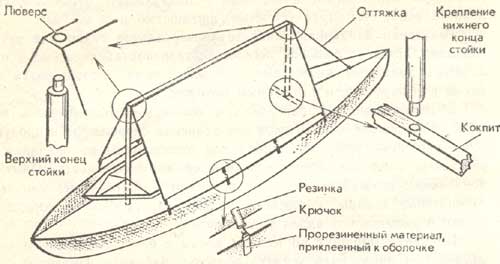 Rice. 8. Canopy for a kayak.
Among the inflatable boats on short routes, you can use light, but small-capacity, one- or two-seater rubber boats produced for fishermen, which exclude movement against the current or wind. On long trips, it is more convenient to use rescue boats (LAS-3, LAS-5), designed for 2-6 people, or larger inflatable boats that allow sailing with a motor.
Tourist rafts. On high-water rivers with strong currents in forested areas, wooden rafts can be built at the starting points of the journey. For this purpose, forestry enterprises purchase 6-8 thick, dead, non-rotten spruce, pine or cedar logs, which are connected by two transverse beams - veneers.
The rafts have rowers: supports for installing large oars - stern and bow rowing - and are sometimes equipped with a luggage rack for backpacks, a mast, and decking.
On simple routes, light rafts called saliks are used. For their construction, smaller logs are suitable, which are connected to each other by crossbars using rope loops. The saliks are controlled using paddles or poles.
In sparsely forested and mountainous areas, pontoon-type rafts (PSN, TLN, SP, etc.), designed for 4-10 people, are most convenient. When rafting on small rivers with a rocky bottom, it is recommended to cover the bottom of an inflatable rubber raft with a tarpaulin. If there are quite serious obstacles on the route, then the pontoon should be strengthened with a wooden frame and racks should be placed on it.
Homemade rafts with separate inflatable elements are also successfully used. They can serve as car (tractor) inner tubes, tied from below with cords under the flexible wooden frame of the raft. Homemade inflatable pontoons are also used, consisting of tubes (vacuum rubber) and tires (rubberized nylon) or ordinary volleyball tubes enclosed in canvas gondola covers.
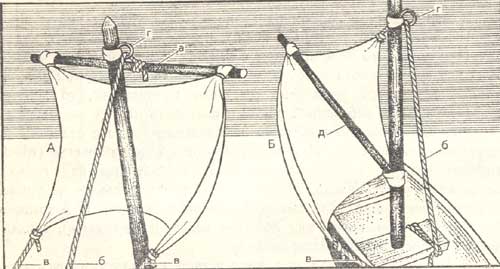 Rice. 9. The simplest sailing rigs - rack (A) and sprint (B): a - rack; b - halyard; c - sheet; g - block; d - sprints
The equipment when traveling on a raft includes an increased number of axes, one or two two-handed saws, strong ropes for rigging, long nails and other fasteners.
Equipment for trips on inflatable rafts and boats includes pumps, additional repair materials, glue, valves, gaskets for them and, if necessary, spare tubes.
Sailing rig. Most types of kayaks, boats, rafts can be used for sailing in a smooth, gentle tail or side wind.
The simplest sailing rig is rack. It consists of a mast and a cross member of a rack, to which is attached a halyard (tackle for hoisting a sail) and a sail, improvised in field conditions from an awning, a piece of polyethylene, a sheet, a thin blanket, a raincoat, a jacket. The sheets are tied to the lower corners of the sail (Fig. 9A). Sprint weapons are also available for manufacturing on the route. A thin stick (spring) is attached to the rectangular panel of the sail diagonally at the corners, a sheet is attached to the free lower corner, and a halyard is attached to the upper corner. The lower end of the sprint is tied with a rope loop to the mast so that it can rotate 180° around it (Fig. 9B).
For safety purposes, when quickly lowering the sail, a block, metal ring or carabiner must be placed at the upper end of the mast, and the sail area for kayaks must be limited to 2.5 square meters. m, boats - 3.5 sq. m, rafts - 4.5 sq. m.
Large sail sizes are acceptable if the tourist vessel is specially equipped for sailing trips. So, you can convert the kayak into a trimaran with inflated side floats (Fig. 10). The masts, boom, cross-frame, crossbeam, beams for attaching equipment to the bulwarks of the kayak are made of duralumin pipes with a diameter of 30-40 mm with a wall thickness of 1-2 mm, the doors are made of multi-layer plywood, the shrouds are made of galvanized wire with a diameter of 2 mm. The sails are made from teak percale or synthetic canvas. The float shells are made of thin, durable material (PVC film, children's oilcloth). Then the nipple is inserted into the finished shell with a nipple to the open ends of the shell. daughters each have two children's inflatable logs.
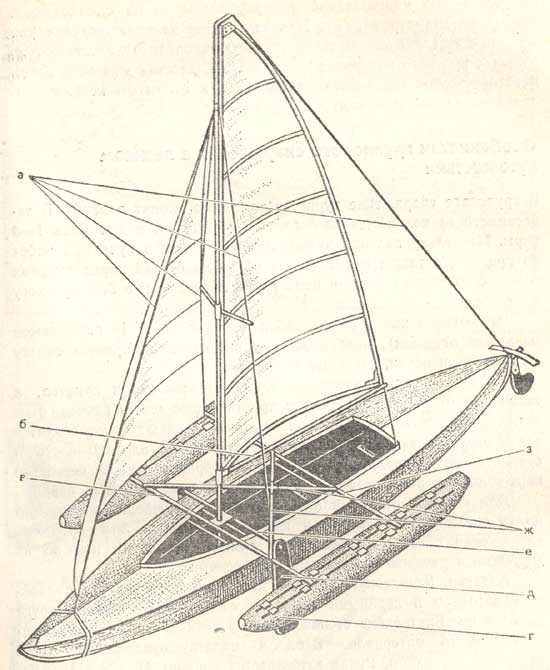 Rice. 10. Conversion of a kayak into a trimaran: a — shrouds; 6 - boom; c - beam; g - float; d - shverz; e - crossbeam; g - frame; h - beam
Features of group equipment on a ski trip
The group equipment of ski tourists includes felt boots. Depending on the quantitative composition of the group, there may be 1-3 pairs. Since felt boots are needed for campfire and kitchen work at a rest stop, and also as spare shoes in case ski boots are damaged, their size should be designed for the largest foot in the group.
It is also necessary to have a set of ski ointments (especially ointment for thawing), plugs for rubbing them, grease for impregnating shoes, and spare fastenings.
On routes that pass far from populated areas and also when tourists do not have practical experience in repairing skis on a hike or in severe frosts, it is recommended to take one or two spare skis. With a fairly dense crust and relatively flat terrain, it is advisable to have several. sled-volokush, the role of which can be played by plastic sleds.
For hikes of the second and higher difficulty categories, it is advisable to have a special tent and a portable stove. These pieces of equipment are usually made by tourists themselves or according to their drawings and cut by various workshops.
Tents, An insulated winter tent can be made with a double ceiling and double walls, separated from each other by 5-8 cm. The inner walls are made of percale, the outer walls are made of waterproof material. The entrance to the tent is a hole with a sleeve. The sleeve is tightened with a cord. Above the entrance there is a hole for the chimney, onto which an asbestos jacket is put on at the junction with the fabric of the tent.
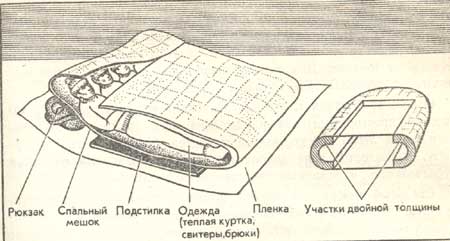 Rice. 11. Multi-person winter sleeping bag.
Another option is a single-layer tent. It can have vertical side walls 50-70 cm high and a tent top with a slope of 40°. Tied skis are placed in the center of the tent as a central stake. Instead of a floor, a large sheet of polyethylene is laid on the snow. The edges of the tent are folded inwards and pressed down with things. For thermal insulation, foam mats are placed under sleeping bags.
General requirements for winter tents: they must be spacious enough to accommodate the entire group, high enough and easy to dry by the fire (tents freeze easily). In a treeless area, additional requirements are wind resistance and air tightness of tents.
Sleeping bag. In winter conditions, you should prefer a multi-seat one - for three to six (Fig. 11). The bag can be made from several single bags with long detachable zippers or from warm cotton blankets. It is advisable to have a two-layer bag, which is easier to carry and dry when disassembled.
Camping stove. Its designs are closely related to winter tents. In a relatively small tent, a hanging stove measuring 250 X 200 X 120 mm with an upper door and a rotating ash flap is used. In the more spacious one there is a stove measuring 350 x 250 x 180 mm with sliding legs or a device for attaching to the tent riser (Fig. 12).
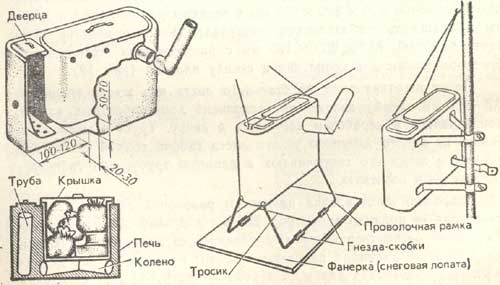 Rice. 12. Oven for cooking food, its installation and transport position
The stove is made of steel sheet or tin 0.3-0.5 mm thick. The pipe is made of several cone-shaped parts that are retracted into the stove when not in use. The pipe can be made from one long narrow sheet of flexible thin steel: when installing the stove, it is rolled into a long pipe, and during transportation - into a short one.
It is possible to manufacture a completely dismountable camp stove. Its basis is a cylinder with a diameter of 220 mm and a length of 350 mm, made from a rolled sheet of cold-worked steel 0.3 mm thick. Covers are placed on the bases of the cylinder: in one of them there is a door with an adjustable blower, in the other there is a pipe for attaching the pipe. The weight of the stoves is 1.5-2 kg. Ovens must be carried in covers,
Medical kit
Composition of a first aid kit. The equipment for a multi-day trip for a tourist group of 6-8 people includes a first aid kit consisting of the following items:
| Name of the product | Quantity pcs. or weight in g. | Application and dosage |
| Sterile bandages (wide and medium *) | 8—10 | Sterile dressing material |
| Elastic bandages | 1—2 | Dressing material for sprains |
| Medical cotton wool | 200 г | |
| Bactericidal adhesive plaster | 10 | For sealing minor abrasions, scratches, abrasions |
| Medical thermometer | 1 | |
| Scissors | 1 | |
| Iodine in ampoules and cases | 10 | Treatment of small wounds or skin around large wounds |
| Potassium permanganate | 10 г | For rinsing, washing, water disinfection, wound treatment, lotion for burns |
| Diamond green 1% alcohol solution | 10 г | For treating abrasions and scratches |
| Hydrogen peroxide | 10 г | For treating wounds |
| Boric acid (powder) | 10 г | Eye wash |
| Medical alcohol | 200 г | For rubbing, disinfection |
| Drinking soda tablets | 20 | For gargling, washing eyes (weak solution), for stomach pain, heartburn, for gastric lavage |
| Streptocide white powder | 20 г | For sprinkling wounds, abrasions, burns, frostbite |
| Ammonia in ampoules and cases | 3 | Give inhalation when losing consciousness |
| Syntomycin ointment (penicillin, tetracycline, etc.) in a tube | 1 | External remedy for abrasions, wounds, burns, frostbite |
| Glue "BF" in a tube | 1 | Apply to minor wounds, scratches |
| Baby cream in a tube | 1 | Emollient for abrasions and diaper rash |
| Anti-influenza serum with sulfonamides | 10 г | Give inhalation into the nasal passages for a runny nose, catarrh, flu |
| Pyramein (or analgin and amidopyrine separately) in tablets | 20 | Remedy for headaches, toothaches and other pains, one-time use - 1 tablet. |
| Salol with belladonna (besalol) in tablets | 20 | For abdominal pain, 1 tablet. 3 times a day |
| Acetylsalicylic acid 0.5 g in tablets | 10 | Antipyretic agent 1 tablet. 3 times a day |
| Bitter (Epsom) salt | 100 г | Laxative, given for food and other poisoning, 2 teaspoons per glass of water |
| Caffeine tablets 0.1 g | 10 | Cardiac stimulant. Single dose - 1 tablet. |
| Cordiamine | 20 г | Calming and cordial. One-time dose 20-25 drops |
| Validol tablets | 10 | For pain in the heart, 1-2 tables. under the tongue |
| Sulfadimethoxine tablets 0.5 g | 20 | For sore throats and colds, 1 tablet. 2 times a day |
| Tetracycline (erythromycin, vitacycline) in tablets of 100,000 units | 20 | For inflammation of wounds, pneumonia, infectious diseases, including intestinal diseases, 1-2 tablets every 4-6 hours |
| Echteroseptol (phthalosol, sulgin) in tablets of 0.5 g | 20 | For gastrointestinal diseases, diarrhea, 1-2 tablets. in 4-6 hours |
| Eye drops (albucid solution) | 10 г | For inflammation of the mucous membrane of the eyelids - 2 drops. in both eyes |
* Individual first aid packages are included in personal equipment.
On a mountain and ski trip, the first aid kit also includes creams and ointments such as “Shield”, “Nivea”, “Luch” to protect against burns. When traveling to places where there are a lot of blood-sucking insects, your first aid kit includes repellents.
The camping first aid kit is packaged in a sealed package that reliably protects medications from water, snow and sunlight, as well as from shock and shaking.
Injections. If the group has a specially trained medical instructor who knows how to give injections, then the first aid kit is additionally recommended to have:
| Designation | Quantity | Application and dosage |
| 3 ml syringe with needles | 1 шт. | |
| Compact sterilizer | 1 шт. | |
| Caffeine 10% | 3 amps. | A stimulant. For bleeding, shock, suffocation, freezing - 1 ml |
| Promedol (pantopon or morphine) | 3 amps. | Painkiller. For traumatic shocks - 1 ml |
| Ephedrine (adrenoline) | 3 amps. | For blood loss - 1 ml |
| Penicillin, streptomycin | 10 amp. | For pneumonia, 200-300 thousand units. 4 times a day |
| Camphor oil | 5 amp. | Stimulates cardiac activity. For heart failure, for freezing - 2 ml |
| Novocaine | 10 amp. | For diluting penicillin, etc. |
| Antitetanus serum | 5 amp. | For wounds, open fractures about 1,500 units. |
| Lobelia 1% | 3 amps. | Stimulates breathing - 1 ml |
On routes where there are venomous snakes, the first aid kit is also equipped with anti-venom serum.
PREPARING EQUIPMENT FOR TRAVEL, CARE AND REPAIR
Checking and modifying equipment
Before traveling, it is necessary to check the completeness of the equipment and clarify whether individual pieces of equipment are suitable for others. It is useful to have the same type of equipment for all tourists in the group. This allows you to interchange its individual parts if necessary, include fewer items in the repair kit, and most importantly, make it easier to complete the route.
The reliability, integrity of the equipment, and its suitability for its intended purpose must be checked in an environment similar to a field trip. Identified deficiencies are immediately eliminated and preventive repairs are carried out. Equipment is tested for its maximum permissible load. So, ski poles (two together) must support the weight of the skier and not bend. The ice ax should not break under a static load of 80-90 kg. When testing an ice ax, it is placed on supports with the head and the clip of the pin and placed in the middle of the handle. When testing a kayak, its stability is checked by bringing the vessel to the overkill in a safe place, buoyancy limits are determined by deliberate overload, etc.
Preparing equipment for travel is also expressed in its fine-tuning, adjustment, alteration, or equipping it with additional devices and devices to ensure better operation and create certain conveniences along the way.
Thus, preparing clothes consists of adjusting them to the height of the group members, strengthening loops and buttons, if necessary, insulating them, impregnating them, and strengthening weak points. For example, in order to extend the service life of woolen socks and avoid darning them, it is recommended to sew patches made of thin percale, an old nylon stocking or a heel pad on the heels and toes of woolen socks before going out on a route.
Additional (including internal) pockets can be sewn onto the storm jacket, and existing pockets can be equipped with fasteners. For winter hikes, it is advisable to line the sleeves of a storm jacket with woolen cuffs on the inside, and make loops on the edges of the sleeves for gartering mittens. For those who are going on a mountain trip, it is recommended to sew waterproof pads on the back and knees of the trousers, sew zippers into the narrow trouser legs from below to the knees so that you can take off the trousers without taking off your shoes, and sew a small gauze canopy to the headdress to protect against sunburn.
Impregnation and lubrication
Fabrics. Before traveling, a backpack, tent, storm suit, cape (unless they are made of rubberized or other waterproof materials) must be soaked with special mixtures.
One of the best options is to use industrially produced water-repellent tent impregnations. In the aerosol version, 200 g of the drug (a mixture of silicone resin, catalyst and solvent with propellant) is consumed to treat 1 square meter. m of cotton fabric. To achieve maximum water-repellent effect, the fabric should then be kept unfolded for three days.
Fabric can be made waterproof using one of the following methods (according to S. V. Obruchev):
1. Place the fabric in a warm soapy solution (500 g of soap per 4 liters of water). Then squeeze it out and immerse it in a saturated alum solution. It’s even better if you add 25 g of laundry soda and 450 g of rosin powder to the soap solution.
2. Place the fabric in a 40 percent solution of laundry soap and, when it is soaked, take it out and dip it in a 20 percent solution of copper sulfate. Then dry (the fabric turns green).
3. Mix a solution of lead acetate (30 g per 1 liter of water) and a solution of aluminum sulfate (21 g per 0.35 liter of water), shake and strain through muslin. Then put the fabric in this mixture for a quarter of an hour and dry without squeezing.
4. Wet the fabric in a solution of 100 parts water, 4 parts alum, 2 parts fish glue and 1 part laundry soap. Then wring out the fabric and rinse it in a 4% solution of lead acetate.
If the travel route passes through places where there are a lot of blood-sucking insects (midges), the tent and storm suits are impregnated with repellent. For example, a 15% methyl phthalate emulsion.
Hiking shoes. The shoes are soaked in grease and, if necessary, stretched over the leg. To do this, the boots need to be kept in hot water (50-55° C) for ten minutes. The temperature should be carefully controlled, since the skin does not stretch up to 40°, and at 60° it deteriorates. Having taken the boots out of the water, put insoles into them and put them on your feet while hot (on one or two pairs of thick woolen socks). After walking in the boots for an hour or two, they are taken off, stuffed with paper and lubricated. Shoes are impregnated with slight heating. If necessary, the hard parts of the boots (especially the seams) are carefully beaten with a hammer.
In addition to the water-repellent impregnation, mountain tricone boots should be placed in water with the soles for several hours before going out on the route so that they swell and hold the tricones better.
Ointment for hiking and ski boots consists of the following parts: castor oil - 100 g, bleached linseed oil - 10 g, turpentine -. 10 g, natural wax - 10 g. To prepare the lubricant, the components must be mixed, having first crushed the wax. Then place the dishes with the resulting composition in a pan of water and heat with stirring until the wax is completely dissolved.
Natural drying oil is also used for impregnation; after 2-3 hours, the shoes are rubbed with laundry soap. This operation is repeated 3-4 times. Of the ready-made lubricants, creams of the “Silicone” type are recommended.
Skis. The sliding surface is impregnated while hot - near a stove, a fire, or over a primus stove. For impregnation, tar, liquid ski waxes and special compounds are used: for hardwood skis - a mixture of equal quantities of tar, paraffin and turpentine; a mixture of 1 part paraffin and 4 parts pine resin; for skis made of soft wood - a mixture of 75 percent tar, 20 percent paraffin and 5 percent shoe polish.
Solid aluminum ointment has proven itself to be effective in combating sticky snow in hiking conditions. It is prepared by adding aluminum dust (paint) to melted paraffin in a ratio of 1:2.
Packing equipment in a backpack
The requirements for packing a backpack are very strict: with the smallest external dimensions, it must have as much internal volume as possible, and its significant weight must be combined with absolute ease of carrying by a tourist. The backpack should be laid out so that it becomes like a part of the tourist’s body and does not harm good posture, but contributes to its preservation.
A backpack shaped like a ball or a cucumber will definitely rub your back. The lower part of the backpack should be concave, repeating the shape of the lower back, and fit snugly against it. The backpack should lean against your back and not put pressure on it. This requirement is best met when using easel backpacks. In ordinary backpacks, you have to put soft things on your back (not in a thick layer) and adjust the length of the straps. A homemade internal frame made from a sheet of duralumin or thin plywood significantly improves the shape of the backpack.
The general rule when packing equipment is: heavy items down, soft items toward the back, bulky and fragile items at the top, essential items in the pockets. It is unacceptable for some poorly packed objects to rattle and jingle in your backpack while you’re walking.
It is not advisable to place large items on the backpack or tie them to the bottom. However, sometimes, when there are a lot of things or the backpack is small, you have to carry a tent, sleeping bag, etc. In this case, the items (previously wrapped in waterproof material) must be pulled as tightly as possible with a rope to the backpack so that they are closer to the back or lower back of the tourist. It is unacceptable to tie things, such as buckets or shoes, to the back of the backpack, or to load the back pocket with heavy objects such as an axe, tin cans, etc.
Stowing should ensure that the backpack is stable on your back. Therefore, you should fill its lower corners especially tightly and by pre-packing things in “blocks” (paper, cardboard, bags) to prevent them from moving in the backpack under the influence of shocks or shaking. This packaging allows you to quickly get the things you need out of your backpack.
For easily breakable items, special protective covers must be made. Thus, a thermometer for measuring air temperature can be safely carried in a backpack if it is placed in a piece of metal tube with a diameter of about 2 cm and sealed with corks and foam pads.
Pre-wrap the thermos with soft things, the camera can be put in a pot or wrapped in soft things and placed closer to the backpack flap. The most “shock-hazardous” places of a backpack are at the bottom and outer pockets. You can't put anything breakable in there.
Rubber glue and gasoline should be carried in aluminum flasks. To avoid spilling medications in the first aid kit or other liquids on the necks of the bottles, it is recommended to wear rubber nipples or finger guards.
Equipment care
Poor care of equipment leads to its damage or loss. There are known cases when tourists were forced to stop traveling due to damage to boots recklessly left by the fire, burning of a tent from sparks from an unsuccessfully placed fire, bending of skis thrown anywhere without spacers, loss of matches, axes, buckets, etc. To avoid this, the following rules should be followed.
When traveling, personal responsibility is established for each piece of equipment. When transferring an item temporarily to another, demand its return only into your own hands.
Use bright colors for easily lost items or tie them down. For example, paint grocery bags, cords, and shoe covers orange - and they will be clearly visible both in dark grass and on white snow. Carry a knife, compass, notepad, pencil on laces tied to your pocket (belt). Tie an elastic band to the ears of your glasses so that if you fall, they will not come off or break.
Before you think about going on vacation, check your equipment and make sure it is in good condition. Don’t put off inspecting and repairing your equipment until the morning. If possible, shelter your equipment from the weather and do not scatter it around the camp site.
Be very careful when drying things near an open fire or on heating devices. It is especially risky to dry shoes near a fire. This can lead to their partial and sometimes complete unsuitability for further use. It is better to dry shoes by stuffing them with moisture-absorbing objects - socks, rags, paper, straw.
Repair on the go
Repair of tent, backpack, clothing. Torn areas are usually sewn up with threads or patches are applied using BF-b glue. The surfaces to be joined are lubricated with glue, allowed to dry, lubricated again, dried, and then joined. It is advisable to subject the joint to heat treatment - press it with hot stones (instead of ironing it with an iron). Small holes are sealed with a strip of adhesive tape or insulating tape.
Repair of the kayak shell. Proceed in the following order: cut out a rubber patch according to the shape and size of the torn area with an allowance of 4-6 cm around the perimeter; sand the surfaces to be glued with sandpaper or a file; remove rubber shavings; wash surfaces with purified gasoline; Apply a thin and even layer of rubber glue to the patch and shell with your finger and allow it to dry for 5-10 minutes (“until it melts”); repeat lubrication and soaking and finally apply a patch to the damaged area and press it over the entire surface.
If the hole is small, then it is hastily sealed on both sides with adhesive tape. If the shell is significantly damaged, it must first be sewn together with harsh threads, and then glued.
Broken stringers and frames are restored using wooden tires.
Ski repair. A plywood tire is placed on top of the ski, and a tin tire is placed on the sliding surface, repeating the groove of the ski with its curves. If there is no breakage, but a crack appears, this place must be immediately reinforced with tin or an aluminum plate.
For high-quality repairs, you can use cold-cured epoxy resin and fiberglass. The scraps of skis are coated with freshly prepared glue, carefully folded and, if necessary, reinforced with fiberglass. The glued area is placed not far from the stove: the resin hardens at a temperature of 30-50° in a few hours.
When applying tires and rearranging fasteners, holes for screws are made using drills. The screws are lubricated with liquid ski wax before screwing in.
Repair kit
(based on a group of 6-8 people)
| Designation | Number of pieces. while traveling | |||
| on foot | mountain | water | skiing | |
| Triangular file | 1 | 1 | 1 | 1 |
| Needle file | 1 | 1 | 1 | 1 |
| Small universal pliers | 1 | 1 | 1-2 | 1-2 |
| Awl | 1 | 1 | 1 | 1 |
| Screwdriver large | 1* | 1* | 1 | 1 |
| Small screwdriver | 1 | 1 | 1 | 1 |
| Drills (2-5 mm), gimlet | - | - | 2 | 2 |
| Touchstone (bar) | 1 | - | 1 | 1 |
| Set of sewing needles | 1 | 1 | 1 | 1 |
| Set of shoe needles | 1 | 1 | 1 | 1 |
| Safety pins | 10-15 | 10-15 | 10-15 | 10-15 |
| Hooks, clothespins | 10-15 | 10-15 | 10-15 | 10-15 |
| Thimble | 1 | 1 | 1 | 1 |
| Sewing threads (black, white) No. 10-20 in spools | 2 | 2 | 2 | 2 |
| Darning (in a skein) | 2 | 2 | 2 | 2 |
| Draped thread, rough thread (in a skein) | 1 | 1 | 1 | 1 |
| Rubber band, m | 3-5 | 3-5 | 3-5 | 3-5 |
| Warp tape, m | 10-15 | 10-15 | 10-15 | 10-15 |
| Insulating tape (in a roll) | - | - | - | 2-3 |
| Alloy plates (tin) 100x200 mm, thickness 0.5-0.8 mm | - | - | - | 2-3 |
| Thick copper wire, m | 1 | - | 1 | 1 |
| Soft copper wire, m | 2 | 2 | 3-4 | 3-4 |
| Cotter pins | - | - | - | 3-4 |
| Washers | 3-5 | 3-5 | 5-10 | 5-10 |
| Various screws | 5-10 | 5-10 | 15-20 | 30-40 |
| Bolts with nuts | 3-5 | 3-5 | 5-10 | 5-10 |
| Various small nails | 10-15 | 10-15 | 20-30 | 30-40 |
| Various long nails (12-15 cm) | - | - | 30* | - |
| Aluminum rivets | 3-5 | 3-5 | 3-5 | 3-5 |
| Ten-layer plywood 90x150 mm | - | - | 1-2* | 1-2 |
| Ski pole rings | - | - | - | 1-2 |
| Aluminum ski nose, removable | - | - | - | 1 |
| Clay BF-6 | 1 | 1 | 1 | 1 |
| Pieces of tarpaulin, leather, percale | set | set | set | set |
| Buttons | 5-10 | 5-10 | 5-10 | 5-10 |
| Scissors | 1 | 1 | 1 | 1 |
| Emery cloth (paper | - | - | 5-10 | - |
| Rubber glue, l | - | - | 0,2-0,5* | - |
| Refined gasoline, l | - | - | 0,1-0,2* | - |
| Rubber for patches | - | - | set* | - |
| Scraps of plywood, boards | - | - | set* | - |
| Tow, resin, tar | - | - | set* | - |
| The plaster is wide | - | - | 1 | - |
| Spare couplings for stringers | - | - | 3-5* | - |
| Cold curing epoxy resin, curing agent and fiberglass | set* | set* | set* | set* |
| Cables for ski bindings | - | - | - | 2-4* |
| Var shoemaker | set* | set* | set* | set* |
| Cables, straps, locks for ski bindings | - | - | - | 2-4* |
| Spare ski edges | - | - | - | 2-4* |
| Heel, welt, plantar triconi | - | 20-40* | - | - |
| Staples, screws for tricones | - | 40-60* | - | - |
* Taken depending on the specific equipment of the group.