
8. Sleeping bags
For a good rest, you need light, compact, comfortable bags that retain heat well. They should dry quickly and be easy to transport. The best thermal insulation is the down of waterfowl and synthetic bulk materials.
Down is soft, has good thermal insulation, but is hygroscopic and easily wrinkles, causing thermal insulation to deteriorate.
More dense filling of the bottom panel of the pawn with down leads to an increase in the weight of the bag rather than to eliminating this drawback. It is better to use a lightweight polyurethane foam or polyethylene foam mat for the bottom. The thickness of a sleeping bag for winter hikes should not exceed 5-7 cm, for summer hikes in the mountains - 3-4 cm, in valleys - 1-2 cm. The thickness of a sleeping bag should be understood as the overall average thickness of the bag, its materials, including fabric, down, and air layers.
Of the commercially available sleeping bags for sports trips, it is better to use blanket bags with various synthetic insulation. They are quite suitable for traveling in summer, in mid-mountain and warm areas. In winter, in treeless areas and in the highlands, when spending the night above the snow line, only down bags or bags with synthetic insulation equivalent to down are suitable.
However, the best bags are still homemade. A single sleeping bag provides higher comfort compared to a multi-person sleeping bag; There are no problems when distributing people among tents when a group is forced to separate (reconnaissance, drop-off, etc.).
A multi-person bag is lighter and cheaper than a single bag per person (about 30% for a three-person bag), and it is warmer to sleep in. If you join two single-person blanket bags using a detachable zipper, you can get a three-person sleeping bag, although less comfortable than a single-person sleeping bag. A multi-person bag, in addition to being less comfortable, is not always easy to carry due to its large volume; in addition, it requires a certain number of people in the group, a multiple of the bag’s capacity.
Double bags inserted into each other have worked well on winter hikes. These bags are warmer than regular ones, although somewhat heavier. Double bags retain heat better due to the air gap, are more convenient to transport, and dry better. If it’s warm, both bags can be used separately as summer bags.
As mentioned above, waterfowl down (eider, duck, goose) is the most effective as insulation. Chicken fluff, without a fat coating, gets wet and takes a long time to dry and rot.
Recently, especially on winter hikes, synthetic fillers (sintepon, nitron, etc.) have been used. They are low hygroscopic, sag slightly, durable, not so scarce and quite cheap, although they are somewhat heavier and colder than down and take up more volume.
Fabrics used for down bags should be down-proof (for example, calendered nylon and percale for the top and lighter cotton fabric for the inner cover; thin parachute nylon is used for the pers-towns that form the down sections).
A bag with synthetic insulation can be sewn entirely from ordinary parachute nylon.
The main designs of sleeping bags according to the method of forming its package: two-layer quilted, two-layer with bulkheads, three-layer and four-layer (Fig. 44 a). The most commonly used design for average temperatures is a two-layer structure with bulkheads, and for winter - a four-layer structure. Four-layer designs are technologically advanced, easily ventilated thanks to the air gap in the bag and have good thermal protection.
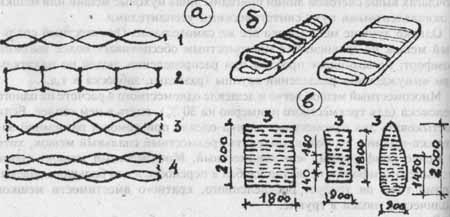 |
| Rice. 44. Basic designs of sleeping bags: a) formation of a down bag (1. Two-layer quilted. 2. Two-layer with bulkheads. 3. Three-layer. 4. Four-layer); b) variants of bag shapes - “cocoon” and “blanket”; c) drawings of the cut of the “cocoon” and “blanket” (1, 2. Upper and lower panels of the “cocoon”. 3. One of the panels of the “blanket”). |
The best thermal insulation is air. Any filler only creates volume for it and eliminates its movement. The optimal filling density of a bag with down is 12-15 g/dm2. A sleeping bag requires 1-1.3 kg of down.
Sleeping bags mainly have two forms - “cocoon” and “blanket” (Fig. 44 b). For a blanket bag, a two-layer design with bulkheads is more suitable; for a cocoon bag, a four-layer structure is more suitable.
In Fig. 44 c provides cutting drawings for both types of single bags. The cocoon consists of an upper and lower 2 panels; blanket - made of two panels 3 measuring 180 x 200 cm.
There are various sewing methods: a complex, labor-intensive method (Fig. 44 a2), but with minimal consumption of quilting fabric; the method in which the quilting fabric is alternately sewn to the outer and inner covers is also quite complex (Fig. 44 a3); A simpler bag is made of two parts inserted into each other, it is easier to dry, but the bag is heavier (Fig. 44 a4). The last method is most suitable for making homemade bags.
The easiest way to sew a rectangular single sleeping bag. By sewing a long zipper into it, you can get a sleeping bag-blanket. It is better to sew it with a headrest (Fig. 45 a).
More difficult to manufacture, but warmer and lighter, is the cocoon sleeping bag, four more designs of which are shown in Fig. 45 b, c, d.
The shortened sleeping bag “elephant foot” is even lighter and smaller (Fig. 45 d). It is sewn in the form of a shortened cocoon and is used in combination with a warm down jacket. An “elephant’s foot” is colder than a full sleeping bag.
For one of the simple designs of a single down sleeping bag “cocoon-2” (Fig. 45 b), you need 8 x 1 m of calendered nylon for the outer and inner covers and fabric for quilting. For filling, 0.8-1.0 kg of fluff is required. The weight of the finished bag is 1.4-1.8 kg, depending on the amount of fluff and the material of the covers.
It is convenient to cut parts from nylon fabric with a sharp tip of an electric soldering iron, placing the fabric on a solid base.
It is more convenient to sew a bag in the following sequence:
• cut out the details of the outer and inner covers;
• cut out the quilting details with an allowance of 1-2 cm;
• attach quilting material to the outer and inner covers so that the seams are shifted relative to each other;
• sew up the down compartments on one side, fill them with down and sew them up on the other side;
• sew the upper and lower parts of the outer and inner bags, sew the inner and outer bags along the ABC and ADS lines;
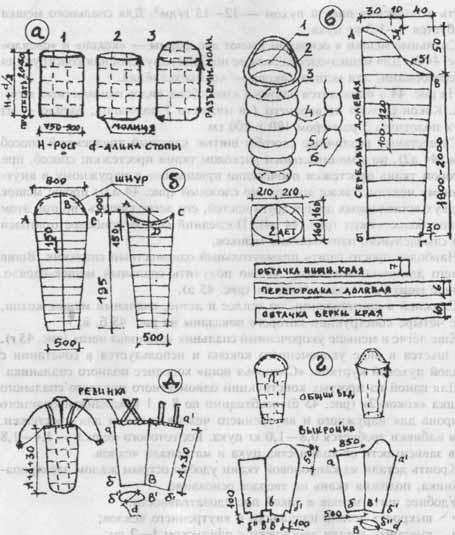 |
| Rice. 45. Single sleeping bags: a) rectangular single sleeping bags (1. One-piece. 2. Blanket sleeping bag. 3. Blanket sleeping bag with zippers); b) cut of the sleeping bag “Cocoon-2”, c) version of the sleeping bag “Cocoon-3” (1. Headband. 2. Facings. 3. Tightening cord. 4. Partitions. 5. Top. 6. Linings); d) sleeping bag options “Cocoon-4” and “Cocoon-5”, e) Sleeping bag “Elephant Foot” (1. Regular. 2. With an extended back part). |
• stitch the top edge of the bag for the tightening cord (dotted line in Fig. 45 b), thread the cord. Single sleeping bag “Cocoon-3” (Fig. 45 c). The top of the bag is made of calendered nylon, the lining is made of teak. The pattern is designed for a person 170-176 cm tall with a chest volume of up to 100 cm and is given with a seam allowance. Down consumption is about 1.5 kg, fabric consumption is 12 m2.
It is better to sew a bag in the following sequence:
• cut out the details of the top and lining, sew the parts along line A-B;
• attach partitions 4 to top 5 and lining 6;
• sew up pockets on one edge;
• sequentially, starting from the bottom, fill the pockets with down and sew them up;
• stitch the headband and thread the tightening cord, stitch the down-filled bag along the B-D line with an overlap, sew on the bottom and stitch it.
A multi-person sleeping bag can be sewn in the form of a rectangular bag. It is good to make a dart in the legs for the foot (Fig. 46a). A more convenient multi-person bag with a headrest made of light cotton fabric sewn to the top edge (Fig. 46 b).
Double blanket bags are convenient to use and as simple blankets, they are easier to dry. If such a sleeping bag is narrowed towards your feet, it will become lighter and take up less space.
A double sleeping bag is made from thin, preferably calendered, nylon. The insulation can be synthetic padding, the number of layers of which depends on the thickness and purpose of the sleeping bag. It is better to use nylon threads.
Down bags, which are more expensive, pay off on mountain hikes.
You can use an insert in sleeping bags for autumn-spring and winter hikes, and do without it in the summer.
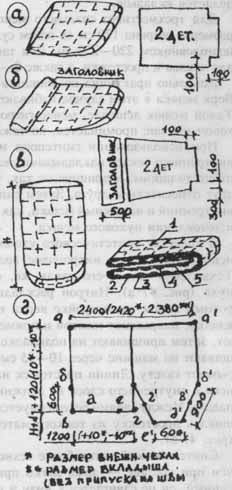 |
| Rice. 46. Multiple sleeping bags: a) rectangular; b) sleeping bag with headrest; c) general view of the sleeping bag with liner; d) the cut of the sleeping bag. |
The general view of such a bag is shown in Fig. 46.v. The top half of the bag should be shorter by the length of your foot. The outer cover of the sleeping bag is sewn according to the pattern of the inner one, increased by 1 cm in length and 2 cm in width.
At first, the cutters made the inner and outer covers. Along the contour, they are basted to the nylon of the outer cover and quilted every 30 cm along the length and width. The same is done with the inner cover, but when applying one cover to another, the stitching should not match. Then the sidewall and bottom of each cover are sewn separately. Insert the inner cover into the outer one so that the side seam of one of them is on the left and the other on the right. Finally, sew the two covers together. The liner is made in the same way.
For a three-person sleeping bag, we can recommend the following dimensions: width 170 cm (narrow at the feet to 150 cm), length 180-190 cm, with a headrest 220-230 cm. For such a bag you need 17.5 x 1 fabric for covers and quilting, as well as 2-2.5 kg of down. The weight of the bag is 3.2-3.6 kg.
The combination of down with synthetic insulation is quite practical. In this case, the top of the bag is stuffed with down, and the bottom is made of padding polyester. Such a bag is cheaper, less hygroscopic, and more technologically advanced. Sintepon sag less, but is heavier and more voluminous than fluff.
When using padding polyester, two or three layers of insulation are applied to the cut out parts of the outer and inner covers (depending on its thickness) and sewn so that the seams on the covers are shifted relative to each other. Then the inner and outer bags are sewn together, as when making a down bag.
Nitron fiber is also used as synthetic insulation. The technology for sewing it is the same as for down (Fig. 47 a). The nitron is laid out in an even layer on the pattern of the top and lining, covered with newspaper and basted, then sewn on the lining, stitched by machine every 10-15 cm and the newspaper is torn off. The stitching lines of the outer and inner layers should not coincide. It is recommended to sew a quilt of thin material between the layers (Fig. 47 b).
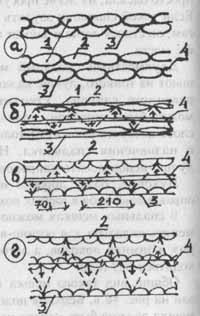 |
| Rice. 47. Technology of sewing synthetic insulation. |
Synthetic batting is more technologically advanced when sewing - even lightly stitched, it does not move to the bottom and does not compact in the form of rollers. Better thermal insulation due to air layers is achieved if the batting is sewn in the form of corrugation (Fig. 47 c). For a sleeping bag you will need 1-1.3 m2 batting and 7 m of fabric with a width of 85-90 cm.
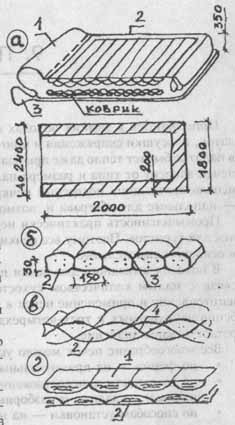 |
| Rice. 48. Double multi-person sleeping bag: a) general appearance, main dimensions, location of stitches; b), c), d) options for stitching panels with various insulation materials. |
A double multi-person sleeping bag (Fig. 48) can be sewn from thin nylon with synthetic padding insulation. To prevent it from bunching up, it is stitched along the length and width. The bag has a headrest 1, making the bag more comfortable and warm. The headrest is made of light cotton fabric of such a width that it can be thrown behind the head and pressed against the back of the head. A bag 3 made of thin nylon is sewn to the edge of the bag under the head for storing things under the head. It is advisable to line the sides and legs of the bag with calendered nylon or bologna fabric 2.
It is better to sew the bag in the following order:
• cut four panels according to the dimensions indicated in the figure;
• spread two or three layers of insulation between two panels and quilt them every 15-20 cm;
• sew the blankets together, overlapping the sides;
• sew a bottom 25-30 cm wide.
Options for sewing panels with various insulation materials are shown in Fig. 48 b, c, d. When using down (eider, duck, etc.; and synthetic wool insulation (nitron), partitions 3 or intermediate lightweight material 4 are sewn between the outer 1 and inner 2 panels.
Nitron, spread out in an even layer of the desired thickness, can be sewn to the panel through a sheet of newspaper (Fig. 44d). Sheet padding polyester is also sewn on. The lines of the outer and inner stitching should not be combined.